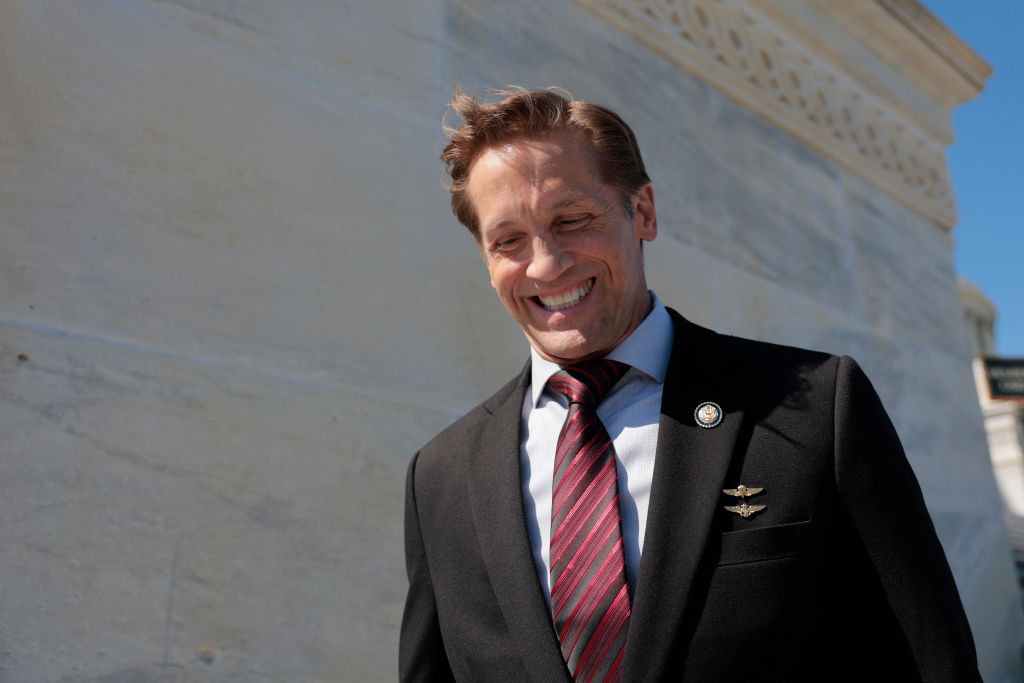
Another member of Congress — this time, a Republican who represents a swath of suburbs north of Atlanta — has violated a conflict-of-interest and transparency law with botched stock-trade disclosures.
Rep. Rich McCormick of Georgia failed to properly report his purchases of two dozen individual stocks from March 2023, according to an OpenSecrets analysis of congressional financial disclosure records.
McCormick last year disclosed the trades in his annual personal financial report to Congress, which all members of Congress are mandated to submit.
But he waited almost two and a half years past a separate 45-day federal deadline for publicly revealing details about individual stock trades in what are known as “periodic transaction reports,” as required by the Stop Trading on Congressional Knowledge Act of 2012. The PTRs are a “contemporaneous reporting requirement” designed by Congress to ensure the public can quickly determine whether a lawmaker’s personal financial trades conflict with their public duties.
Taken together, McCormick’s stock purchases are worth between $24,024 and $360,000. (Lawmakers are only required to disclose the value of their stock trades in broad ranges.)
Among the stocks McCormick purchased in 2023: Apple, Cisco Systems, Costco Wholesale, Emerson Electric Company, Home Depot, pharmaceutical company Johnson & Johnson, defense contractor L3Harris Technologies, Microsoft, NextEra Energy, Pepsico, UnitedHealth Group and Walmart.
A second-term lawmaker, McCormick is a member of the Armed Services Committee, Foreign Affairs Committee and Science, Space and Technology Committee; some of the transactions involve shares of companies whose industries fall under the jurisdiction of one or more of these committees.
McCormick’s congressional office acknowledged a phone inquiry from OpenSecrets but did not otherwise respond to follow-up phone messages or emailed questions.
The congressman’s stock disclosure snafu coincides with a bipartisan push in Congress to ban federal lawmakers from trading stocks altogether.
It’s a seemingly odd coalition, with far left members such as Reps. Alexandria Ocasio-Cortez of New York and Pramila Jayapal of Washington teaming with far-right legislators such as Sen. Josh Hawley of Missouri and Rep. Chip Roy of Texas.
But they together argue that the STOCK Act’s penalties for violations are too weak and dozens of their colleagues have violated the law with little or no consequence.
During this year alone, numerous members of Congress have violated the STOCK Act’s public disclosure provisions, including Republicans Sen. Markwayne Mullin and Reps. Dan Meuser, Lisa McClain, Austin Scott, Neal Dunn, Scott Franklin, Brandon Gill, Hal Rogers, Tim Moore and Troy Nehls.
STOCK Act violators among Democrats include Reps. Debbie Wasserman Schultz, Dwight Evans, Jamie Raskin, Chellie Pingree, Shri Thanedar, George Whitesides, Ritchie Torres, Jonathan Jackson, Donald Norcross, Tom Suozzi, George Latimer, Val Hoyle and Jared Huffman.
Dozens of other lawmakers have violated the STOCK Act in recent years.
The standard fine for a first-time STOCK Act disclosure violation is $200 fine. But the House and Senate ethics committees may waive such penalties and often do.
“The public trust in Congress is really low, and the low trust is self-inflicted,” said former Rep. Charles Boustany, a Louisiana Democrat who served in Congress from 2005 to 2017 and now works with Issue One, a nonprofit government watchdog group. “With these stock violations, it’s a stark indication that new legislation is necessary to restore trust. There also needs to be more disclosure, fines need to be stiffer.”
At present, pro-stock-ban lawmakers are pressing the Restore Trust in Congress Act, an amalgamation of several previously introduced stock-ban bills. In July, a Senate committee advanced a similar measure, known as the HONEST Act, to the full chamber.
A handful of stock-trading members of Congress have of late voluntarily abstained from stock trading to avoid actual or perceived financial conflicts of interest. They include Sen. Peter Welch (D) of Vermont and Reps. George Whitesides (D) of California, Greg Landsman (D) of Ohio and Julie Johnson (D) of Texas.
Congressional disclosures indicate that McCormick himself has not bought or sold individual stocks during 2025.
Dave Levinthal is a Washington, D.C.-based investigative journalist. He served as OpenSecrets’ editorial and communications director from 2009 to 2011.