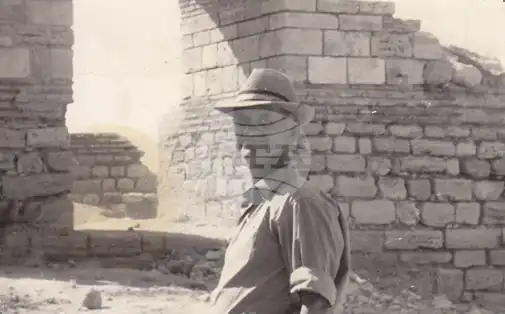
Balgarianovinite.com “Archaeology instils in a person a constant spirit of inquiry. Everything else is already a gift. I am, above all, a historian and only then everything else.” This is how the distinguished Bulgarian archaeologist, historian, Thracologist, and philologist Professor Ivan Venedikov (1916–1997) defined his vocation in an interview with Bulgarian National Radio. January 10 marks the 110th anniversary of his birth.
Family and education
Ivan Venedikov was born on January 10, 1916, in Sofia. His mother’s family first moved from Bitola to Plovdiv, and later to the capital. His father was retired General Yordan Venedikov (1871–1954), commander of the First and Fourth Cavalry Regiments, originally from the village of Banya, Razlog region.
In 1929, Venedikov enrolled in the classical department of the First Boys’ Gymnasium, where he studied Latin and Greek. He graduated in 1934 and began studying classical philology at the Faculty of History and Philology at Sofia University “St. Kliment Ohridski”. By 1938, he had become an assistant, discovering a particular passion for archaeology.
His classical education under eminent professors laid the foundation for his future academic career. His thesis, Phonetics of Latin Inscriptions in Bulgaria, established him as a reliable specialist in the study of the ancient past.
Early excavations
After graduating in 1939, Venedikov began work as a curator at the newly opened archaeological museum in Skopje, a branch of the Sofia Museum. His first expedition was to Stip in 1942, and he also carried out excavations in the vicinity of Radanje and the Bash Tepe site, where he discovered the ancient and medieval city of Bargala (Bregalnica) and the medieval town of Koziak.
During his time in Macedonia, Venedikov enriched the museum with finds from the Early Iron Age — the so-called “Macedonian bronzes” — which later became a central theme in his studies of Thracian art.
In 1944 he returned to Sofia and became curator at the Archaeological Museum, where he conducted the first excavations of the necropolis of ancient Apollonia Pontica (modern-day Sozopol), examining over 768 graves. This marked the beginning of research into maritime history and underwater archaeology in Bulgaria.
He subsequently conducted investigations in the villages of Kasnakovo (Haskovo region), Lilyache (Vratsa region), at the Madara Rider, the Kazanlak Tomb, and others.
In 1948, the Archaeological Institute and its museum were transferred to the Bulgarian Academy of Sciences (BAS). Venedikov was appointed junior research fellow and became a senior research fellow in 1968. Together with Professor Alexander Fol, he led expeditions of the Institute of Thracology in Strandzha, Sakar, and the Eastern Rhodopes in the early 1970s. He was among the first researchers of megalithic and rock-cut monuments in Bulgaria and laid the foundations for hypotheses regarding the origins of Thracian built tombs. His article on the rock heroon at Tatul remains fundamental in Thracology.
International recognition
In 1974, together with Alexander Fol, Ivan Venedikov organised the first major exhibition on the Thracians abroad — Thracian Art at the Petit Palais museum in Paris. This was his first contact with Western scholars and an international audience. Exhibitions followed at the British Museum in London, the Metropolitan Museum in New York, in Mexico, the Netherlands, Canada, Japan, and many other countries. Venedikov was the driving force behind the concept of these exhibitions, meticulously selecting and arranging the exhibits.
From 1972 to 1976, Venedikov worked at the newly established Institute of Thracology at BAS. Until his retirement in 1986, he headed the Bulgarian Lands in Antiquity Department at the National Museum of History. For his colleagues, Venedikov was not just a scholar but a living encyclopedia. Meetings and conversations with him were memorable — he spoke captivatingly, remembered everything, and thought aloud, never keeping ideas to himself. He treated young researchers with attention and patience, encouraging them to ask questions and debate, while his presence was infectious and inspiring.
In his museum work, Professor Venedikov became a benchmark. Where others hesitated, he saw a solution — in a detail, a trace of use, or an analogy from a distant region. His accumulated experience and broad knowledge allowed him to grasp the significance of a newly discovered find at first sight. He received his professorial title in 1980.
Scientific legacy
Ivan Venedikov authored over 15 books, many of which gained wide recognition abroad for his innovative ideas and interpretations. More than 30 of his works were published internationally and translated into English, French, German, Russian, Italian, Spanish, Turkish, Hungarian, Czech, Polish, and Japanese. Professor Venedikov also created and wrote documentaries, television programmes, and radio broadcasts dedicated to Bulgarian antiquity and the Middle Ages.
Among his most significant studies are: The Lands along the Middle Vardar. Contribution to the Ancient Geography of Macedonia (1943), The Ancient Tomb near Pomorie (1960, co-authored), The Thracian Chariot (1960), The Secret of the Thracian Mounds (1968), Thracian Art (1973, co-authored), The Vratsa Treasure (1975), The Copper Treading Floor of the Proto-Bulgarians (1983), The Golden Pillar of the Proto-Bulgarians (1983), The Birth of the Gods (1992), and By Their Deeds You Shall Know Them: Memoirs (1993). He also authored more than 200 scientific papers in Thracology, archaeology, epigraphy, folklore, prehistory, linguistics, ethnography, numismatics, and medieval Bulgarian history.
Professor Ivan Venedikov passed away on August 19, 1997, in Sofia. In his honour, on April 6, 2023, the Sofia Municipal Council named a street in the Vitosha Borough after him, commemorating his legacy in the capital. 110 Years Since the Birth of Professor Ivan Venedikov, Pioneer of Bulgarian Archaeology 2026 THE NEWS FROM BULGARIA – NEWS AGENCY 2009-2025 2026-01-10 21:44:46 Latest news World news Country news Most important news latest news most important latest of the day Justice Petar Nizamov Feathers Petar Nizamov- Feathers Justice bg iustitia.bg iustitia iusticia usticia investigation Burgas Bulgaria news news of the last hour news of the day news of today Bulgaria news The news from Bulgaria blitz news top news most important most commented latest news Boyko Borisov news weather coronavirus news news weather facebook youtube facebook instagram news today news of the last minutes news today today news news bg news leading news hot news bg news site for news all news news bg news of the last hour latest latest news bg news of today news today news today news of the last hour latest news today news bg news news 24 hours news vesti bg novini news world bird bg bivol bg bivol trud bg novini latest news today novinite bg news hello bulgaria political party coat of arms delyan peevski scandalous Bulgarian National Television Free Europe Television scandal exclusive live tv live right now tv tv online tv program bg live now tv news online tv online live court Burgas court Burgas district court Burgas court Burgas district court Burgas district court Burgas appellate court Burgas prosecutor Burgas prosecutor’s office Burgas district prosecutor’s office Burgas district prosecutor’s office Burgas district prosecutor’s office Burgas district prosecutor’s office Burgas district prosecutor’s office Burgas district prosecutor’s office Prosecutor General Ivan Geshev Prosecutor Geshev Tsatsarov Ministry of Internal Affairs Burgas ODMR Burgas ODPR Burgas police Burgas district police Burgas prosecutor Tsatsarov SGS cases Varna court chairman of the SGS court decisions on civil cases decisions on cases Plovdiv court decision of the court decisions cases Varna court criminal cases district district court decisions work in the court SGS chairman of the SGS judges Sofia court post judges Plovdiv court Plovdiv judges Plovdiv Supreme Court Inspectorate Supreme Court Supreme Judicial Council lawyer lawyer criminal cases lawyer civil cases lawyer marriage cases lawyer administrative criminal law criminal process civil law civil process administrative law constitutional law