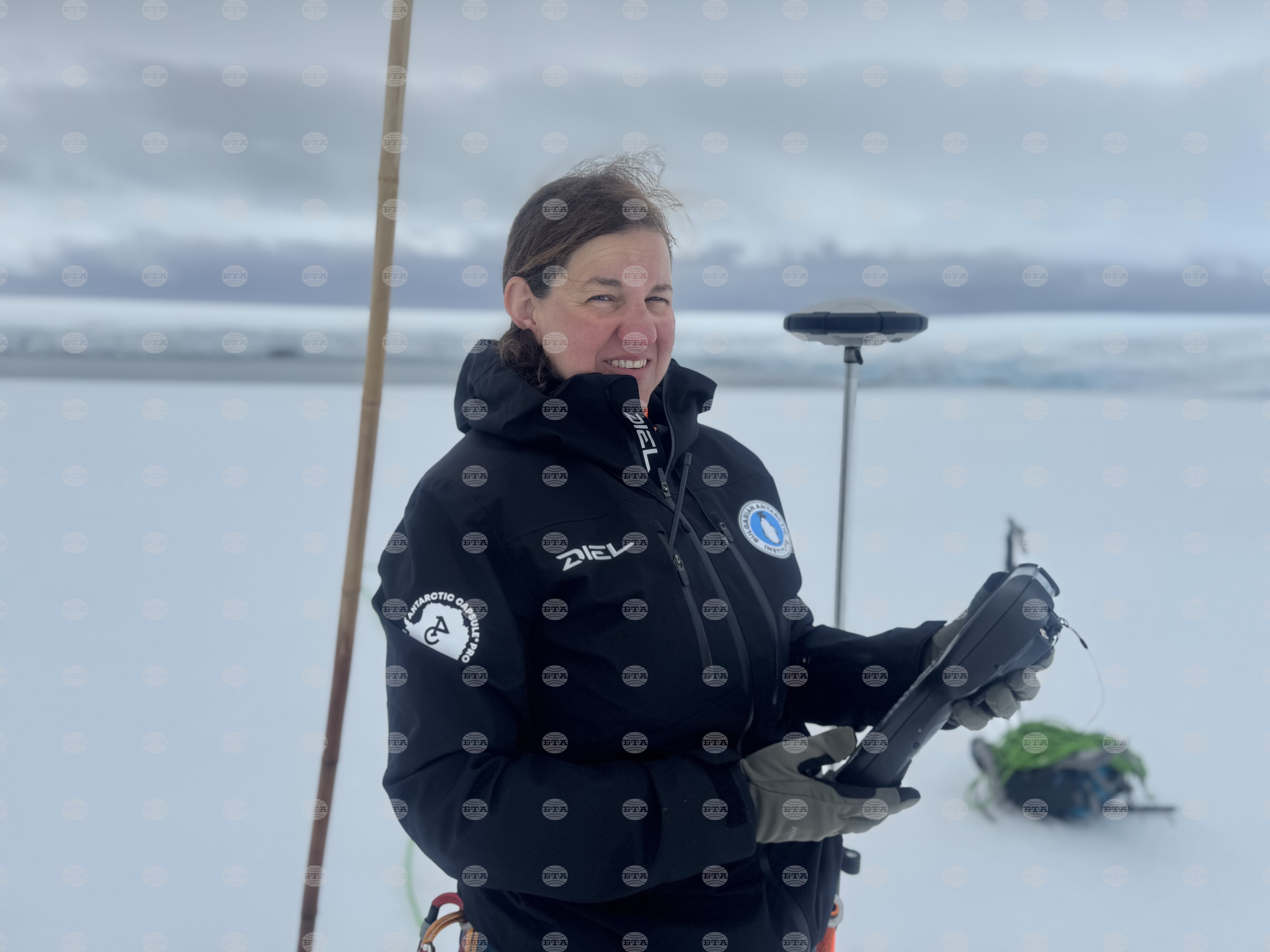
Balgarianovinite.com Systematic research in regions such as Antarctica is extremely important because it reveals the long-term condition of glaciers and the direction of their development, seismologist Gergana Georgieva said in a BTA interview.
Georgieva is a chief assistant professor at the Faculty of Physics of Sofia University. Her main research focus is the structure of the Earth and the propagation of seismic waves from strong earthquakes. For the past ten years, she has been studying glacier seismicity. The 34th Bulgarian Antarctic Expedition is her eighth mission to the Bulgarian Antarctic Base St. Kliment Ohridski.
“In 2015, under our first project, we installed a seismic station with the same equipment as the stations in Bulgaria. Initially, it operated only when there were people at the base, and we removed it for the Antarctic winter,” she said.
She added that after the first year this approach proved unsustainable and risky for the equipment. As a result, the team began leaving the instruments in place, with seasonal installation and removal.
“In 2020, we relocated the station to a more sheltered site and left it to record year-round. From a partially operating station, it became a permanent one and is now among the few seismic stations in Antarctica that, in theory, record data continuously throughout the year,” Georgieva explained.
At present, the Bulgarian Antarctic base cannot fully support such equipment year-round. During the Antarctic winter months, August and September, there is about a one-month interruption due to lack of power, as the station is located one kilometre from the base and relies on solar energy and batteries.
“Over the past ten years, we have recorded more than 1,000 earthquakes and tens of thousands of seismic events – signals caused by ground movement that are not earthquakes. In Antarctica, these seismic events are actually icequakes resulting from glacier movement,” the seismologist explained.
According to her, these are not earthquakes that people feel strongly. The reason is that base buildings are designed to withstand wind and shake much more during strong winds than during an earthquake of magnitude 5.
“In the past ten years, there were three earthquakes in the South Shetland Islands region with magnitudes of around 6.8, but they were farther from the Bulgarian base and were not felt by us,” she added.
“When the project for the new laboratory was being prepared, I was asked to assess the seismicity of the area. Before the seismic station was installed, this was very difficult because no one knew what kind of earthquakes occurred there. Now that we are present on site, we can observe the local seismicity,” Georgieva said.
She explained that her task this year is to monitor the seismic station, download the data and check that everything is functioning properly.
“My main task is to carry out glacier measurements. We have 16 markers placed at specific points on the glacier surface, and another eight on the Kontel Glacier from last year,” she said. “We can measure the coordinates of these markers to track glacier movement—not only how fast it moves and in which direction, but also whether the speed changes over time. This is interesting and useful information. Studies show that glaciers that are melting and shrinking tend to slow down. At the same time, in the lower part of a glacier, where summer melting predominates, warming can increase the speed because meltwater begins to flow and accelerates the glacier.”
The seismologist noted that these processes remain poorly studied, especially in Antarctica. Existing studies are largely based on satellite data, which are most reliable when combined with ground-based observations.
“Our work is important because of the ground measurements. In recent years, our efforts have focused on systematic monitoring. Over a period of 10 to 15 years, we need to accumulate consistent data. Systematic research in a region such as Antarctica is crucial because it shows the long-term condition of glaciers and the prevailing trends,” Georgieva said.
She added that sufficiently long-term studies currently exist for fewer than 20 glaciers worldwide, most of them in the Alps and the Himalayas.
“I would not say that Antarctic glaciers are disappearing, because we do not yet have the data to support that. We need systematic research over at least 15 years, which is half of the 30-year climate cycle,” she explained.
According to Georgieva, research in a specific area and the presence of seismic stations in Antarctica are important not only for understanding local seismicity but also for studying global seismicity, as each station contributes to the worldwide seismic network. Such research is also essential for understanding the structure of the Earth.
“Processes in one place are linked to broader processes. Every local study is a small grain of knowledge that will be important in the future,” she concluded.
RSV 421 departed for Antarctica from Varna (on the Black Sea) on November 7. After a month-long voyage across the Atlantic Ocean, the ship arrived at the Argentine naval base in the city of Mar del Plata on December 13, 2025. BTA has had a national press club on board since 2022 and another on Livingston Island since February 2024.
The news pieces of the BTA special correspondents on RSV 421 and Antarctica are freely available in Bulgarian and English on the agency’s website. They can be used free of charge by all media with reference to BTA. Systematic Antarctic Research Vital for Understanding Long-Term Glacier Trends, Says Seismologist 2026 THE NEWS FROM BULGARIA – NEWS AGENCY 2009-2025 2026-02-05 22:41:50 Latest news World news Country news Most important news latest news most important latest of the day Justice Petar Nizamov Feathers Petar Nizamov- Feathers Justice bg iustitia.bg iustitia iusticia usticia investigation Burgas Bulgaria news news of the last hour news of the day news of today Bulgaria news The news from Bulgaria blitz news top news most important most commented latest news Boyko Borisov news weather coronavirus news news weather facebook youtube facebook instagram news today news of the last minutes news today today news news bg news leading news hot news bg news site for news all news news bg news of the last hour latest latest news bg news of today news today news today news of the last hour latest news today news bg news news 24 hours news vesti bg novini news world bird bg bivol bg bivol trud bg novini latest news today novinite bg news hello bulgaria political party coat of arms delyan peevski scandalous Bulgarian National Television Free Europe Television scandal exclusive live tv live right now tv tv online tv program bg live now tv news online tv online live court Burgas court Burgas district court Burgas court Burgas district court Burgas district court Burgas appellate court Burgas prosecutor Burgas prosecutor’s office Burgas district prosecutor’s office Burgas district prosecutor’s office Burgas district prosecutor’s office Burgas district prosecutor’s office Burgas district prosecutor’s office Burgas district prosecutor’s office Prosecutor General Ivan Geshev Prosecutor Geshev Tsatsarov Ministry of Internal Affairs Burgas ODMR Burgas ODPR Burgas police Burgas district police Burgas prosecutor Tsatsarov SGS cases Varna court chairman of the SGS court decisions on civil cases decisions on cases Plovdiv court decision of the court decisions cases Varna court criminal cases district district court decisions work in the court SGS chairman of the SGS judges Sofia court post judges Plovdiv court Plovdiv judges Plovdiv Supreme Court Inspectorate Supreme Court Supreme Judicial Council lawyer lawyer criminal cases lawyer civil cases lawyer marriage cases lawyer administrative criminal law criminal process civil law civil process administrative law constitutional law