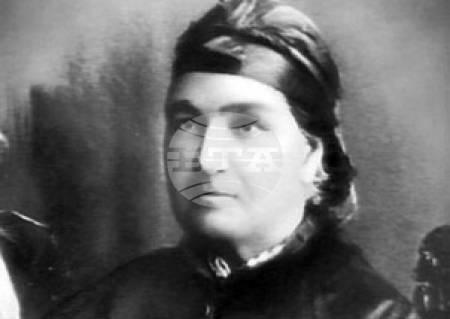
Balgarianovinite.com August 25 marks 200 years since the birth of Nedelya Petkova (1826-1894), a prominent Bulgarian National Revival educator, community leader and revolutionary, and the first Bulgarian woman teacher in Sofia.
Born in Sopot (South Central Bulgaria) on August 25 (Old Style August 13), 1826, Nedelya Delyuva Gulyova acquired basic literacy during three years at the Sopot Convent. To master by herself the Bell-Lancaster method, she paid pupils five to 10 paras to show her how they studied under the monitorial system. At the time, she and Saba Hadzhinikolova, the future mother of Bulgarian national poet Ivan Vazov, were the only literate girls in the town. Saba later recalled her mother scolding her: “You won’t be a nun, but a laywoman. No one knows [how to read], other than Nedelya Gulyova! Is it her that you’re aping, so that’s why you’ve picked up that book!”
Aged 19, Nedelya married Petko Karaivanov, a grandson of the famous haiduk Kara Ivan and, according to a hypothesis for which there is no conclusive evidence, a blood relative of Gena Karaivanova-Kuncheva, the mother of national hero Vasil Levski. Once married, as was customary at that time, the bride adopted her husband’s forename and surname and became known as Nedelya Petkova Karaivanova. Petko, who traded in braided woollen cords and glassware, died of cholera in Pirot in 1856, leaving his wife a widow with five young children and pregnant with a sixth.
20 YEARS IN THE SERVICE OF EDUCATION
Having also lost both her parents, Nedelya supported her family by sewing and embroidery. A chance meeting with influential writer and diplomat Nayden Gerov in Plovdiv in 1858 changed the course of her life. Impressed by her literacy, Gerov recommended her to prominent educator Sava Filaretov as a teacher at the girls’ school he had recently opened in Sofia.
Petkova arrived in Sofia in late October 1858 and taught there for two and a half years, until April 1861. She was the first Bulgarian woman teacher in the town.
She continued to study and improve her own skills, initially working under Filaretov’s guidance. “Am I not well aware that when I came to Sofia I was a wild animal, uncouth,” Nedelya wrote in a letter to Dimitar Traykovich, a wealthy and patriotic resident of Sofia who financed the new educational establishment. Also with his funding, a separate two-storey building for the girls’ school was constructed in 1859-1860. It stood at the corner of what are now Laveleye and Alabin streets, approximately on the site of the present Interior Ministry Museum.
In Sofia, the idea of educating girls initially met with resistance from the “old prejudices that prevail in Turkey, [according to which] girls were supposed to stick to needlework and housewifery”, the Tsarigradski Vestnik weekly, published in Constantinople, noted in a dispatch from Sofia in 1859.
Through considerable effort and enthusiasm, this resistance and indifference were overcome, and the enrolment rose from 80 in late 1858 to about 200 a year later. Some of the pupils, as Filaretov reported to Gerov, could already read and write better than the teacher herself. “In general, the townspeople are pleased with this, and the girls study with great diligence. We have pupils aged from 12 to 18. The older ones, naturally, are better achievers,” the teacher wrote.
“Families without distinction of any kind can freely send their children there without paying anything,” Filaretov explained in a dispatch to Tsarigradski Vestnik in March 1859. “We are pleased that rich and poor are extending a brotherly hand of reconciliation to one another for the sake of everything that is good and useful,” he added.
The curriculum included Scripture (Bible history and catechism), Bulgarian language and grammar, arithmetic, geography, reading, and penmanship (handwriting). The first annual examination, held in August 1860 in these subjects, was highly successful and attended by the Sofia governor, the town’s judge, the Austrian consul, the Metropolitan of Sofia and other guests of honour.
In January 1861, a new teacher from Austria, Rakhil Barak-Dushanova, arrived in Sofia to teach the more advanced pupils both academic subjects and sewing, beadwork, knitting and other “domestic skills”. Barak’s high level of training soon attracted 100 of the 140 girls in Petkova’s charge, forcing her to resign.
The following year, Nedelya accepted a teaching position in Samokov (Southwestern Bulgaria), where she remained until 1864. She then moved to nearby Kyustendil for another two years. On July 1, 1865, she was appointed a teacher in Prilep. Thus began the most intensive period of her educational work in what was then Ottoman Macedonia, where she started the first Bulgarian girls’ schools. In Prilep, she organized the first formal celebration of the feast of the Slav enlighteners St Cyril and St Methodius. By 1866-1867, the school already had more than 180 pupils.
Accounts of her departure from Prilep in 1867 differ. Some of her opponents accused her of inadequate professional qualifications and even of immoral conduct, alleging that she had a “rather frivolous demeanour and smoked tobacco,” as noted by Boyko Kiryakov, the editor of her Reminiscences.
Over the next decade, from 1868 to 1878, Petkova taught in Ohrid, Bitola, Veles (now in North Macedonia) and Salonica (now Thessaloniki, Greece), in most cases together with her daughter Stanislava. With extraordinary stamina, resolve and perseverance, the two Bulgarian women laid the foundations of girls’ education in Macedonia. They braved every deprivation and hardship, persecution, threats, searches and court trials. They lived in poverty and sometimes were not paid their salaries for months. They relied on making lace and embroideries for their subsistence. Hunger was their constant companion.
Like all other champions of Bulgarian education in Macedonia, they frequently came into conflict with the Grecomans (local Orthodox Christians who had yielded to the Helenizing propaganda of Greek clergy and educator) and became targets of intrigues by the Ecumenical Patriarchate of Constantinople.
Around 1865-1870, grateful local people began referring to Nedelya Petkova as “Baba Nedelya” (literally “Grandma Nedelya”), an honorific expressing respect and affection. The title also appeared in official correspondence, reflecting the profound regard and authority she commanded as a symbolic mother and protector of her pupils, as well as her courage in confronting the Ottoman authorities and the Greek clergy on her own. She shared the distinction with other prominent women of the Bulgarian National Revival, such as Baba Tonka Obretenova. After Bulgaria’s Liberation from Ottoman rule in 1878, the title became an integral part of her identity.
At Baba Nedelya’s insistence, the Russian consul in Salonica arranged four state scholarships for girls from Macedonia. In May 1872, she personally accompanied one pupil each from Veles, Voden, Kukush and Salonica to Moscow to enrol at a girls’ school attached to the Alekseevsky Convent.
Petkova and her daughter Stanislava founded the first women’s associations in Macedonia: two in Veles in 1869 and one in Salonica in 1872. In doing so, they ushered in a more modern concept of women participating in public life, pursuing more advanced education, and gaining a degree of emancipation. Baba Nedelya maintained contacts with women’s associations in other Bulgarian towns, sharing their experience in organizing women.
The Salonica association, initially called Revival and later renamed Bulgarian Dawn, was actively involved in education and charity. It subsequently expanded to include a men’s section. As a representative of the association, between November 1873 and May 1874 Petkova visited the surrounding villages, raising funds for the Salonica girls’ school and persuading families to send their daughters there. According to Stanislava, however, the main purpose of the mission was “agitation for the spread of Bulgarian national consciousness”.
Baba Nedelya was also fascinated by Bulgaria’s tangible and intangible heritage. During her tour of the Salonica region, she took particular interest in the legends and folk traditions of each village she visited, as well as the history of local churches, castle ruins, statues, and other antiquities.
REVOLUTIONARY ACTIVITY
Nedelya Petkova also took part in the struggle for an independent Bulgarian Church. She circulated revolutionary songs among the local community and spoke out against Ottoman rule, for which she was repeatedly summoned for questioning by the Ottoman authorities. Stanislava recalls that she and her mother “incited young men to rebellion”. Nedelya successfully refuted a false accusation by the local Greek bishop that she was a Russian agent handing out Russian books to the population.
In late November 1870, a messenger of Vasil Levski called on the two teachers in Veles with a request that they make, within two months, a flag for the internal revolutionary organization. Working only at night and following a supplied pattern, they embroidered a red silk lion with the words “Freedom or Death” above its head and “Rise, So I May Liberate You” below it.
With only five or six nights’ work remaining, Ottoman police raided their house for a search, having been tipped off by an informer. Warned by their landlord, Nedelya and Stanislava quickly realized that there was nowhere to hide the flag. They therefore removed a picture hanging on the wall, stretched the unfinished flag over its frame, and slipped the inscription bands and a revolutionary songbook into a boot.
The police found nothing suspicious but were intrigued by the strange picture on the wall. Nedelya explained that it depicted her grandfather’s favourite dog. The unfinished lion did indeed resemble a dog, and the officers believed her story. Thanks to her composure, the flag was not discovered. Petkova was nevertheless charged with revolutionary activity and sent to trial in Bitola and subsequently Salonica. She was acquitted and released, but had to leave Veles. The subsequent fate of that flag is unknown.
At the end of 1875, a revolutionary group preparing an uprising in Eastern Macedonia emerged around the Bulgarian Dawn Association in Salonica, which Baba Nedelya had originally founded as a women’s organization. Both mother and daughter joined this group, which was led by local teacher Dimitar Popgeorgiev Berovski. The group raised funds, acquired weapons, and built a network of supporters, particularly in the areas of Piyanets and Maleshevo.
In March 1876, the conspirators learned that the Giurgiu Revolutionary Committee was preparing a general uprising in northern and southern Bulgaria for May of that year.
“At that time I had given Slavka Karaivanova and her mother Nedelya a photograph of a crownless lion, so that they could embroider a flag on yellow silk, with the lion in red silk and the inscription ‘Macedonia’. This was kept secret from everyone,” Berovski recalled. The flag also bore the words “Rise, So I MAY LIBERATE YOU”, while a separate piece of cloth sewn onto it by hand carried the inscription “May 8th, 1876”.
May 8 was the Old Style date of the premature outbreak of the Razlovtsi Uprising. On that day, the flag was solemnly unfurled in the village of Razlovtsi (at the foot of Mount Golak in what is now North Macedonia), inspiring the insurgents and the local population.
The flag survived the suppression of the rebellion, which is regarded as part of the April 1876 Uprising, and was later borne by a detachment that Berovski organized during the 1885 Serbo-Bulgarian War. Under that flag, on November 15, 1885, the detachment took part in defeating and driving out enemy forces that had entered Bulgarian territory in the Bosilegrad area. Berovski and his sons preserved the flag, and in 1959 one of them donated it to the National Museum of Military History in Sofia, where it remains today.
After Bulgaria’s Liberation, Baba Nedelya settled in Kyustendil in 1878 and moved to Sofia in 1879. In 1883, she unsuccessfully attempted to open a school for ethnic Muslim Bulgarian girls in the village of Rakitovo, near Pazardzhik (South Central Bulgaria). The National Assembly granted her a small monthly pension of 40 leva.
At the First Agricultural and Industrial Exhibition in Plovdiv in 1892, she won a silver medal for a carpet she wove. Nedelya Petkova passed away in Sofia on January 1, 1894.
NOTABLE DESCENDANTS
The best-known of her descendants was her daughter Stanislava (Slavka) Karaivanova, who used the pseudonym “Balkanova”. Between 1868 and 1878, she taught, either together with her mother or independently, in Bitola, Ohrid, Veles, Voden and Salonica.
On August 1, 1880, she was appointed a telegraph operator in Sofia, becoming the first Bulgarian woman to enter the profession and the first female civil servant in Bulgaria. This happened after five of her job applications were rejected because, as the minister told her, “Miss, how can you not see that we do not yet have women worthy of such a position?” Her sixth application was personally endorsed by the head of state, Prince Alexander I, who said: “I am pleased that in our Bulgaria we will have a woman civil servant.” “It was indescribable joy to have achieved what I had so fervently desired,” Balkanova recalled. “I wanted to embrace and kiss the whole world and tell them: ‘At last, Bulgarian [women], too, have gained equality’.”
At the end of 1893, Stanislava recorded her mother’s and her own reminiscences on 108 handwritten pages. This valuable source on the period is preserved in the Central State Archives in Sofia. It was published, complete with commentary and notes, in 1987.
Under the command of Baba Nedelya’s youngest son, Petko (named after his father who had died before he was born), a Serbian battalion was defeated near the village of Ropot on November 6, 1885. This was the first victory of the Bulgarian army in the Serbo-Bulgarian War. First Lieutenant Karaivanov was awarded the Order of Bravery and was later promoted to captain and major, serving as a battalion commander.
Three of Baba Nedelya’s grandsons: Yeremia, Yurdan and Georgi, were killed in the First Balkan War and World War I.
Another grandson of hers, Petko V. Karaivanov, graduated from the American College in Samokov and spent 42 years (1897-1939) as custodian of the Foreign Ministry’s secret archives and its cipher decoding system. The entire confidential correspondence of the Palace and the diplomatic service passed through his hands, giving him access to all state secrets and developments in international affairs.
When the royal security service questioned his loyalty on account of his American education and relatives in the US, his superior, diplomat Simeon Radev, personally vouched for him, saying: “I may be a spy, but Karaivanov is not,” his son Vasil Karaivanov recalled.
Petko Karaivanov began collecting postage stamps in 1885. He was officially recognized as a philatelic expert in Bulgaria as early as 1910 and was the only Bulgarian philatelic expert recognized abroad. The Sofia Philatelic Society bears his name.
The husband of Nedelya’s granddaughter Zoritsa, Dimitar Furnadzhiev, graduated from college and theological seminary in Princeton. After returning to Bulgaria, he served in five Evangelical churches in different parts of the country and was rector of the Samokov Theological Seminary from 1931 to 1941.
For 32 years (1912-1943), he was the official religious representative of all Evangelical churches in Bulgaria before the Ministry of Foreign Affairs and Public Worship. The Rev. Furnadzhiev was part of Bulgarian government delegations defending Bulgaria’s interests in London in 1913 (after the Second Balkan War) and in Paris for negotiations on the 1919 Peace Treaty of Neuilly (after WW I).
Dimitar’s son and Baba Nedelya’s great-grandson, Vasil D. Furnad, worked for 23 years (1954-1970) at the Voice of America, first as a writer and later as Deputy Chief, and Editor in Chief of the Bulgarian Service. His son, V. R. “Bob” Furnad, joined CNN in 1983. From 1992 he was Senior Vice President and Senior Executive Producer at CNN and, until his retirement in 2001, President of CNN Headline News in Atlanta.
REMEMBRANCE
While Vladimir Vazov was mayor of Sofia (1926-1932), the area at what was then the southern end of Vitosha Boulevard was named Baba Nedelya Square. In the 1980s, the construction of the National Palace of Culture and the laying out of Bulgaria Square virtually erased that square. Only a small dead-end street, also called Baba Nedelya, remains today. Nevertheless, Baba Nedelya Square still figures on maps and is retained in address registrations.
The Nedelya chain of café and pastry shops takes its name from the square, where its first outlet opened in 1993.
On December 15, 2006, the Bulgarian Antarctic Place-names Commission with the Ministry of Foreign Affairs approved the name “нос Неделя” (Nedelya Point) for “the sharp, low ice-free point on the N coast of Livingston Island in the South Shetland Islands projecting 380 m into Barclay Bay”. The feature was “named after the Bulgarian educator Nedelya Petkova ‘Baba (Grandma) Nedelya’ (1826-94)”.
Nedelya Point is included in the Bulgarian Antarctic Gazetteer and in the Composite Gazetteer of Antarctica, kept by the Scientific Committee on Antarctic Research. Its coordinates are 62°36’55.6″S and 60°58’48.5″W.
According to the Register of Pre-school and School Education System Institutions, kept by the Bulgarian Ministry of Education and Science, only one of Bulgaria’s 2,330 operating state, municipal and private schools – the primary school in her native Sopot – bears the name Nedelya Petkova. None of Sofia’s 257 schools is named after the person who pioneered girls’ education in the capital city.
BTA extends its gratitude to its recently retired veteran staffer Lyubomir Gigov for providing information on, materials about, and a photograph of his great-great-grandmother Nedelya Petkova.
Birth Bicentenary of Nedelya Petkova: Educator, Community Leader, Revolutionary 2026 THE NEWS FROM BULGARIA – NEWS AGENCY 2009-2025 2026-08-25 06:01:00
Latest news World news Country news Most important news latest news most important latest of the day Justice Petar Nizamov Feathers Petar Nizamov- Feathers Justice bg iustitia.bg iustitia iusticia usticia investigation Burgas Bulgaria news news of the last hour news of the day news of today Bulgaria news The news from Bulgaria blitz news top news most important most commented latest news Boyko Borisov news weather coronavirus news news weather facebook youtube facebook instagram news today news of the last minutes news today today news news bg news leading news hot news bg news site for news all news news bg news of the last hour latest latest news bg news of today news today news today news of the last hour latest news today news bg news news 24 hours news vesti bg novini news world bird bg bivol bg bivol trud bg novini latest news today novinite bg news hello bulgaria political party coat of arms delyan peevski scandalous Bulgarian National Television Free Europe Television scandal exclusive live tv live right now tv tv online tv program bg live now tv news online tv online live court Burgas court Burgas district court Burgas court Burgas district court Burgas district court Burgas appellate court Burgas prosecutor Burgas prosecutor’s office Burgas district prosecutor’s office Burgas district prosecutor’s office Burgas district prosecutor’s office Burgas district prosecutor’s office Burgas district prosecutor’s office Burgas district prosecutor’s office Prosecutor General Ivan Geshev Prosecutor Geshev Tsatsarov Ministry of Internal Affairs Burgas ODMR Burgas ODPR Burgas police Burgas district police Burgas prosecutor Tsatsarov SGS cases Varna court chairman of the SGS court decisions on civil cases decisions on cases Plovdiv court decision of the court decisions cases Varna court criminal cases district district court decisions work in the court SGS chairman of the SGS judges Sofia court post judges Plovdiv court Plovdiv judges Plovdiv Supreme Court Inspectorate Supreme Court Supreme Judicial Council lawyer lawyer criminal cases lawyer civil cases lawyer marriage cases lawyer administrative criminal law criminal process civil law civil process administrative law constitutional law
БЪЛГАРИЯ НОВИНИТЕ – ИНФОРМАЦИОННА АГЕНЦИЯ 2009-2026 2026-08-25 06:01:00