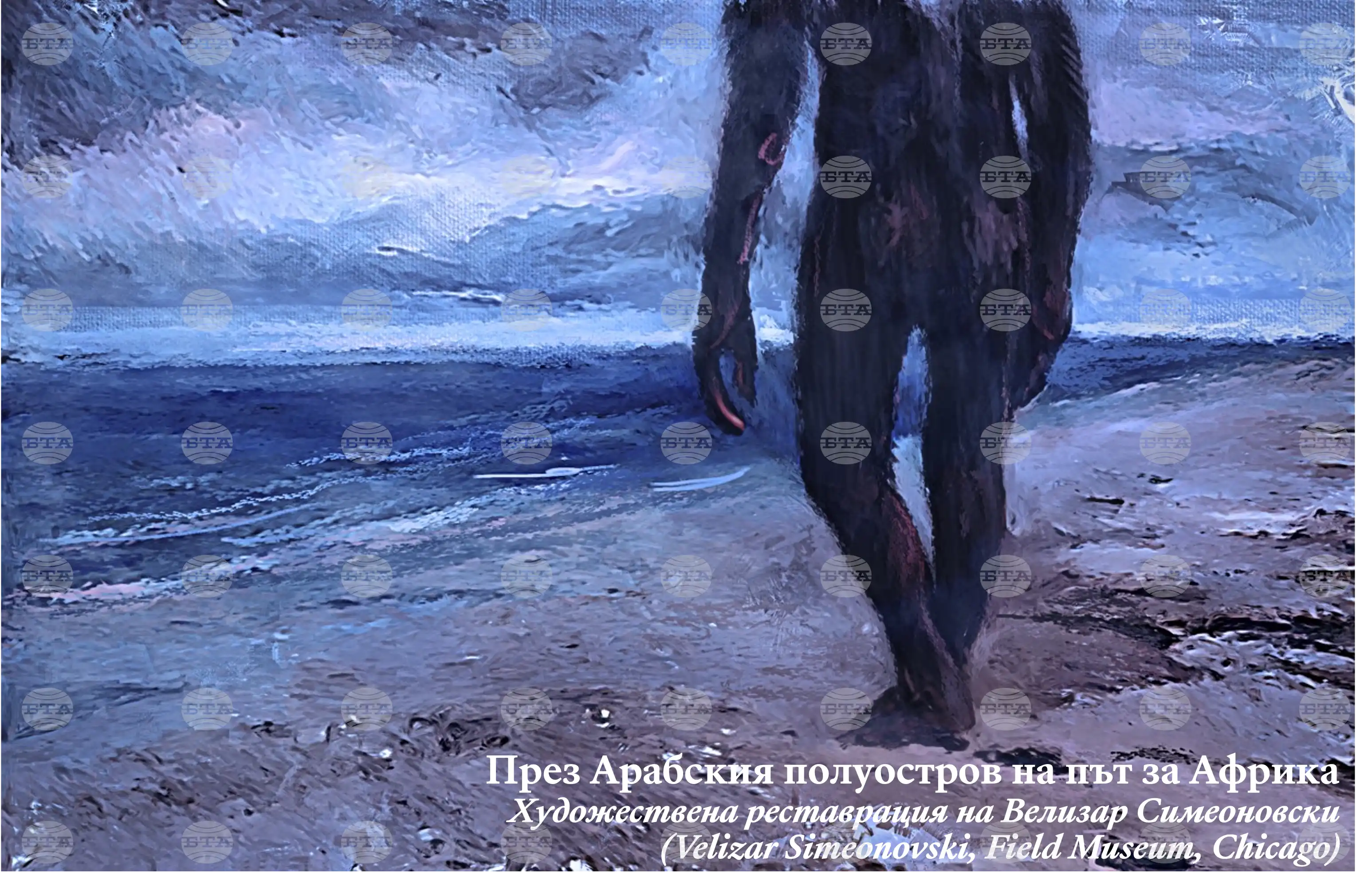
Balgarianovinite.com Scientists have found evidence that the earliest bipedal human-like ancestors lived in the Balkans rather than in Africa. This conclusion follows the discovery of a bipedal hominin that lived in what is now Bulgaria around 7.2 million years ago. The research team, comprising Prof. Nikolai Spassov, Prof. Dionisios Youlatos, Prof. Madelaine Bohme, Ralitsa Bogdanova, Assoc. Prof. Latinka Hristova, and Prof. David R. Begun, published their findings in the journal Palaeobiodiversity and Palaeoenvironments. Their study is titled “An early form of terrestrial hominine bipedalism in the Late Miocene of Bulgaria”.
The article describes a fossil femur from the late Miocene site of 7.2 million years old, Azmaka, near Chirpan (Bulgaria), presumably assigned to the Balkan hominine Graecopithecus. The conclusions reached by the authors of this study are quite unexpected and could change many aspects of the ideas about the earliest evolution of mankind. They will undoubtedly provoke discussion in anthropological circles.
Signs of bipedalism
“The bipedalism has long been considered a fundamental acquisition in the early evolution of hominins and one of the most important of the main characteristics of hominins, the latest of which are humans. Until recently, it was considered that the first hominin capable of walking upright was the 7-6.5 Ma old Sahelanthropus, but the latest research casts doubt on the stated locomotor abilities of this hominid. Another African hominid – Orrorin, shows quite convincing signs of bipedalism, according to most researchers, but this Kenyan hominin existed one million years later than the hominid from Azmaka,” says Prof. Nikolai Spassov from the National Museum of Natural History, Sofia (NMNHS), head of the excavations and first author of this publication.
The quantitative and qualitative analysis of the features of the Azmaka femur convincingly show a unique combination of signs of terrestrial quadrupedal locomotion, with those indicating possibilities for bipedal walking. A number of morphological features of the found femur, such as the elongated femoral neck, the position of the gluteal tuberosity, the disappearance of the distal portion of the intertrochanteric crest, the presence of an intertrochanteric line, the low values of the angle between the body and the neck of the femur, the straight body of the bone and other features show similarity with bipedal fossil hominins and humans and distinguish it from the femora of arboreal apes. The Azmaka hominid is also distinguished from arboreal apes by the asymmetrical development of the cortex of the femoral neck, established by computed tomography scan.
“The multivariate analysis distinguishes the Azmaka femur from European middle and late Miocene hominids (Danuvius, Dryopithecus, Hispanopithecus) and places the Azmaka femur relatively close to the african apes as the chimpanzee, but mostly close to the bipedal hominins as Orrorin, modern man, paranthropus and Australopithecus afarensis,” notes Prof. Dionissios Youlatos from the Aristotle University of Thessaloniki.
These transitional locomotor capabilities and especially the strong arguments showing the ability to move on two legs make the Azmaka hominid the most likely earliest ancestor of man, i.e. the first putative hominin – notes Prof. Spassov.
What did the Azmaka hominid called Diva look like?
According to comparative analysis, the found femur should have belonged to a female with a body mass of only 24 kg, corresponding to approximately an 8-year-old modern girl. Therefore, the found individual was nicknamed “Diva” by the scientists (“Diva” in Bulgarian – “wild”, “wild woman”).
Savannah fauna and environment in Bulgaria and the Balkans 7.2 million years ago
“The fossil femur was found during excavations nine years ago, together with remains of the monkey Mesopithecus, gazelles, other bovids, hipparions, giraffes and rhinos, typical of the Balkan fauna of that time,” explain MSc Ralitsa Bogdanova and Assoc. Prof. Latinka Hristova from the National Museum of Natural History of the Bulgarian Academy of Sciences. This natural environment shows a savannah landscape that was typical of the Late Miocene of the Balkans and of the Balkan-Iranian paleozoozoogeographic province of that time.
Where did humanity take its first steps?
For more than a hundred years, Africa has been considered the cradle of humanity, and the evidence for this is numerous and convincing. So convincing that it was difficult to accept any other possibility. There is indeed no doubt that the vast majority of humanity’s evolutionary path has passed on the African continent. But it seems that the first steps were taken in the Balkans.
The role of the Balkans and Asia Minor at the crossroads of three continents
The Balkans and Asia Minor are particularly important for the evolution and migration of species because they are a crossroads between three continents. There is increasing evidence that today’s savannah fauna of Africa is largely related to Eurasia in origin.
“Our analyses from a previous study indicate that the time between approximately 8/7.5 and 5.5 million years ago was a time of mass migrations of a number of mammal species from the Balkan-Iranian-Afghan region to Africa, but there is no evidence of the reverse process at that time – migrations from the African continent to Eurasia,” explains Prof. Madeleine Bohme from the University of Tübingen. These migrations were caused by climate changes associated with the development of the Arabian Desert, which became a barrier to this faunal exchange between Eurasia and Africa about 5.3 million years ago. One of the migrants could be the aforementioned, already upright Balkan hominin. There is no longer any doubt that during the late Miocene, when the Balkans and the Near East were inhabited by Graecopithecus and its probable direct predecessors – Ouranopithecus from Northern Greece and Anadoluvius from Anatolia, a savannah stretched over a vast territory from Southeast Europe to Iran and Afghanistan (the so-called Balkan-Iranian paleozoogeographic province), with an appearance and fauna similar to those of today’s Africa. There is increasing evidence that with the opening of similar spaces in Africa, many of the Eurasian savannah inhabitants migrated to the African continent.
There are more and more arguments showing that today’s savannah fauna of Africa is largely related to Eurasia in origin.
“Recent data demonstrate that the great ape diversity in the Late Miocene of the eastern Mediterranean is greater than previously believed and that hominines had diversified into multiple taxa long before their first documented appearance in Africa. The new data and analyses accumulated lead to the conclusion that African great apes formed as a taxonomic group in Europe and that most likely the Balkan-Anatolian region, where at least three genera of hominines lived from about 9.6 to 7.2 million years ago, is the source of extant hominine origins,” says Prof. David Begun from the University of Toronto. The putative first hominin – the bipedal hominine discovered in the paleontological site of Azmaka (Bulgaria) also seems, like many other mammals (giraffes, rhinoceroses, hyenas, bovids, etc.), to have spread south to the African continent, where subsequent human evolution continued.
Publication: Nikolai Spassov, Dionisios Youlatos, Madelaine Bohme, Ralitsa Bogdanova, Latinka Hristova, David R. Begun: An early form of terrestrial hominine bipedalism in the Late Miocene of Bulgaria. Palaeobiodiversity and Palaeoenvironments, https://doi.org/10.1007/s12549-025-00691-0 Earliest Bipedal Hominins Lived in the Balkans 2026 THE NEWS FROM BULGARIA – NEWS AGENCY 2009-2025 2026-03-04 15:20:14 Latest news World news Country news Most important news latest news most important latest of the day Justice Petar Nizamov Feathers Petar Nizamov- Feathers Justice bg iustitia.bg iustitia iusticia usticia investigation Burgas Bulgaria news news of the last hour news of the day news of today Bulgaria news The news from Bulgaria blitz news top news most important most commented latest news Boyko Borisov news weather coronavirus news news weather facebook youtube facebook instagram news today news of the last minutes news today today news news bg news leading news hot news bg news site for news all news news bg news of the last hour latest latest news bg news of today news today news today news of the last hour latest news today news bg news news 24 hours news vesti bg novini news world bird bg bivol bg bivol trud bg novini latest news today novinite bg news hello bulgaria political party coat of arms delyan peevski scandalous Bulgarian National Television Free Europe Television scandal exclusive live tv live right now tv tv online tv program bg live now tv news online tv online live court Burgas court Burgas district court Burgas court Burgas district court Burgas district court Burgas appellate court Burgas prosecutor Burgas prosecutor’s office Burgas district prosecutor’s office Burgas district prosecutor’s office Burgas district prosecutor’s office Burgas district prosecutor’s office Burgas district prosecutor’s office Burgas district prosecutor’s office Prosecutor General Ivan Geshev Prosecutor Geshev Tsatsarov Ministry of Internal Affairs Burgas ODMR Burgas ODPR Burgas police Burgas district police Burgas prosecutor Tsatsarov SGS cases Varna court chairman of the SGS court decisions on civil cases decisions on cases Plovdiv court decision of the court decisions cases Varna court criminal cases district district court decisions work in the court SGS chairman of the SGS judges Sofia court post judges Plovdiv court Plovdiv judges Plovdiv Supreme Court Inspectorate Supreme Court Supreme Judicial Council lawyer lawyer criminal cases lawyer civil cases lawyer marriage cases lawyer administrative criminal law criminal process civil law civil process administrative law constitutional law