Balgarianovinite.com
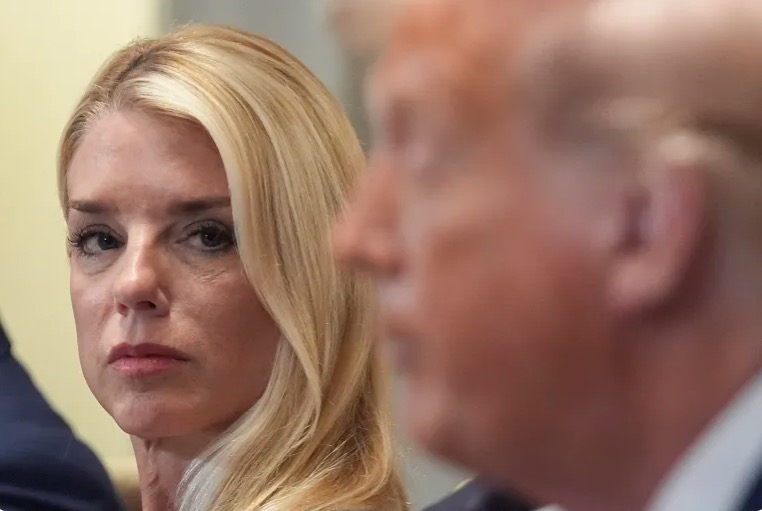
(Evan Vucci/The Associated Press)
The Justice Department is now engaged in an open cover-up carried out in direct violation of federal law.
Over the weekend, the department quietly removed 16 photographs from the Epstein files website it created to comply with a disclosure statute passed by Congress and signed into law by President Donald Trump. The removals came without notice or explanation. Among the deleted images was one of the few photographs that even indirectly featured Trump, a picture of a credenza drawer inside Jeffrey Epstein’s Manhattan home containing other photographs, including at least one of Trump. Twelve others depicted Epstein’s third-floor massage room, a central crime scene in the federal investigation. Some images of the same room remain public. Others disappeared.
When Democrats on the House Oversight Committee asked whether the Trump-related image had been taken down, the Justice Department declined to respond.
What followed made matters worse.
In a post on X quoting Deputy Attorney General Todd Blanche, the Justice Department claimed that “photos and other materials will continue being reviewed and redacted consistent with the law in an abundance of caution as we receive additional information.” Blanche’s original post asserted that the department had released Epstein materials “under the Epstein Files Transparency Act” and that additional disclosures would follow “as our review continues, consistent with the law and with protections for victims.”
That explanation fails under the statute the department invoked.
Congress did not authorize a rolling review. The Epstein Files Transparency Act compels the Justice Department to release all Epstein-related materials in its possession. The law imposes a mandatory disclosure obligation and permits only limited redactions to protect victims. It grants no authority to retract, revise, or curate records after release. Once the department published those materials, the law required that they remain available to the public.
Removing them placed the department in direct conflict with the statute Congress enacted.
That conflict was immediately recognized. Blanche’s post received a community note stating that the law requires the release of all files and allows only narrow redactions to protect victims, adding that the department’s partial release and extensive redactions violated the statute. The Justice Department’s own post received a community note citing the statute directly and stating that retractions and redactions to protect politically exposed persons are not permitted. Community Notes appear only when users with differing political viewpoints agree on their accuracy, underscoring how broadly that conclusion was shared.
The department’s own explanation confirms it is violating the law it claims to follow.
The sequence exposes motive. The files went live. Political reaction followed. The department then altered the public record. Compliance held only until presidential exposure appeared, then gave way to erasure.
In November, I described the Trump Justice Department’s handling of the Epstein files as a cover-up. Last week, I wrote that the administration’s delay in disclosure created a political problem rather than an immediate legal one. That assessment reflected weak enforcement mechanisms and an approach built on delay rather than open defiance.
This moment marks escalation.
Removing already released material that implicates the president converts a credibility crisis into a statutory violation and a far larger political emergency. Congress passed the Epstein disclosure statute precisely to eliminate executive discretion. Lawmakers acted because the Justice Department repeatedly demonstrated it could not be trusted to manage politically sensitive material involving powerful figures. The law mandated disclosure to prevent executive self-protection.
The department seized that discretion anyway.
Attorney General Pam Bondi had lawful options. She could have sought judicial review. She could have consulted Congress. She could have acknowledged that the statute permits no removal authority and sought amendment. Each path would have preserved institutional legitimacy. She chose concealment and false justification instead.
This erasure differs from earlier Trump-era document fights in a crucial way. Prior disputes centered on whether materials must be disclosed. This episode involves evidence already released to the public under statutory standards. The department determined the images satisfied the law’s requirements, then removed them once the political cost became apparent.
That changes everything.
Every disclosure statute now faces the same test: compliance survives only until it threatens the president. Months of delay, sweeping redactions, and staged releases already convinced much of the public that the Justice Department prioritized Trump’s standing over transparency, victims, and the public interest. The image removals confirm that conclusion decisively.
A Justice Department that edits evidence to shield the president forfeits legitimacy. Oversight collapses when obedience ends at political inconvenience. The rule of law depends on statutes binding the executive even when compliance proves costly.
Congress wrote a law to prevent exactly this abuse. The president signed it. The attorney general is now violating it to protect him. That meets any reasonable standard for impeachment.
The backlash on Capitol Hill was immediate and bipartisan. Democratic Rep. Ro Khanna of California, who co-authored the Epstein Files Transparency Act, and Republican Rep. Thomas Massie of Kentucky, who forced the House vote compelling disclosure, both said the Justice Department failed to comply with the law. Khanna has confirmed that he and Massie are drafting impeachment and contempt measures against Attorney General Pam Bondi.
Congress now faces a choice. It can accept that disclosure laws apply only when politically painless. It can normalize the disappearance of already public evidence. It can allow executive power to override legislative command.
Or it can enforce the law it wrote.
This is a cover-up enforced through executive defiance. The question now is whether Congress will enforce its own laws.
The post Impeachable: Pam Bondi Defied Federal Law by Erasing Epstein Photos to Protect Trump first appeared on Mediaite.
Impeachable: Pam Bondi Defied Federal Law by Erasing Epstein Photos to Protect Trump 2025 THE NEWS FROM BULGARIA – NEWS AGENCY 2009-2025 2025-12-21 16:02:32 Latest news World news Country news Most important news latest news most important latest of the day Justice Petar Nizamov Feathers Petar Nizamov- Feathers Justice bg iustitia.bg iustitia iusticia usticia investigation Burgas Bulgaria news news of the last hour news of the day news of today Bulgaria news The news from Bulgaria blitz news top news most important most commented latest news Boyko Borisov news weather coronavirus news news weather facebook youtube facebook instagram news today news of the last minutes news today today news news bg news leading news hot news bg news site for news all news news bg news of the last hour latest latest news bg news of today news today news today news of the last hour latest news today news bg news news 24 hours news vesti bg novini news world bird bg bivol bg bivol trud bg novini latest news today novinite bg news hello bulgaria political party coat of arms delyan peevski scandalous Bulgarian National Television Free Europe Television scandal exclusive live tv live right now tv tv online tv program bg live now tv news online tv online live court Burgas court Burgas district court Burgas court Burgas district court Burgas district court Burgas appellate court Burgas prosecutor Burgas prosecutor’s office Burgas district prosecutor’s office Burgas district prosecutor’s office Burgas district prosecutor’s office Burgas district prosecutor’s office Burgas district prosecutor’s office Burgas district prosecutor’s office Prosecutor General Ivan Geshev Prosecutor Geshev Tsatsarov Ministry of Internal Affairs Burgas ODMR Burgas ODPR Burgas police Burgas district police Burgas prosecutor Tsatsarov SGS cases Varna court chairman of the SGS court decisions on civil cases decisions on cases Plovdiv court decision of the court decisions cases Varna court criminal cases district district court decisions work in the court SGS chairman of the SGS judges Sofia court post judges Plovdiv court Plovdiv judges Plovdiv Supreme Court Inspectorate Supreme Court Supreme Judicial Council lawyer lawyer criminal cases lawyer civil cases lawyer marriage cases lawyer administrative criminal law criminal process civil law civil process administrative law constitutional law