
Balgarianovinite.com

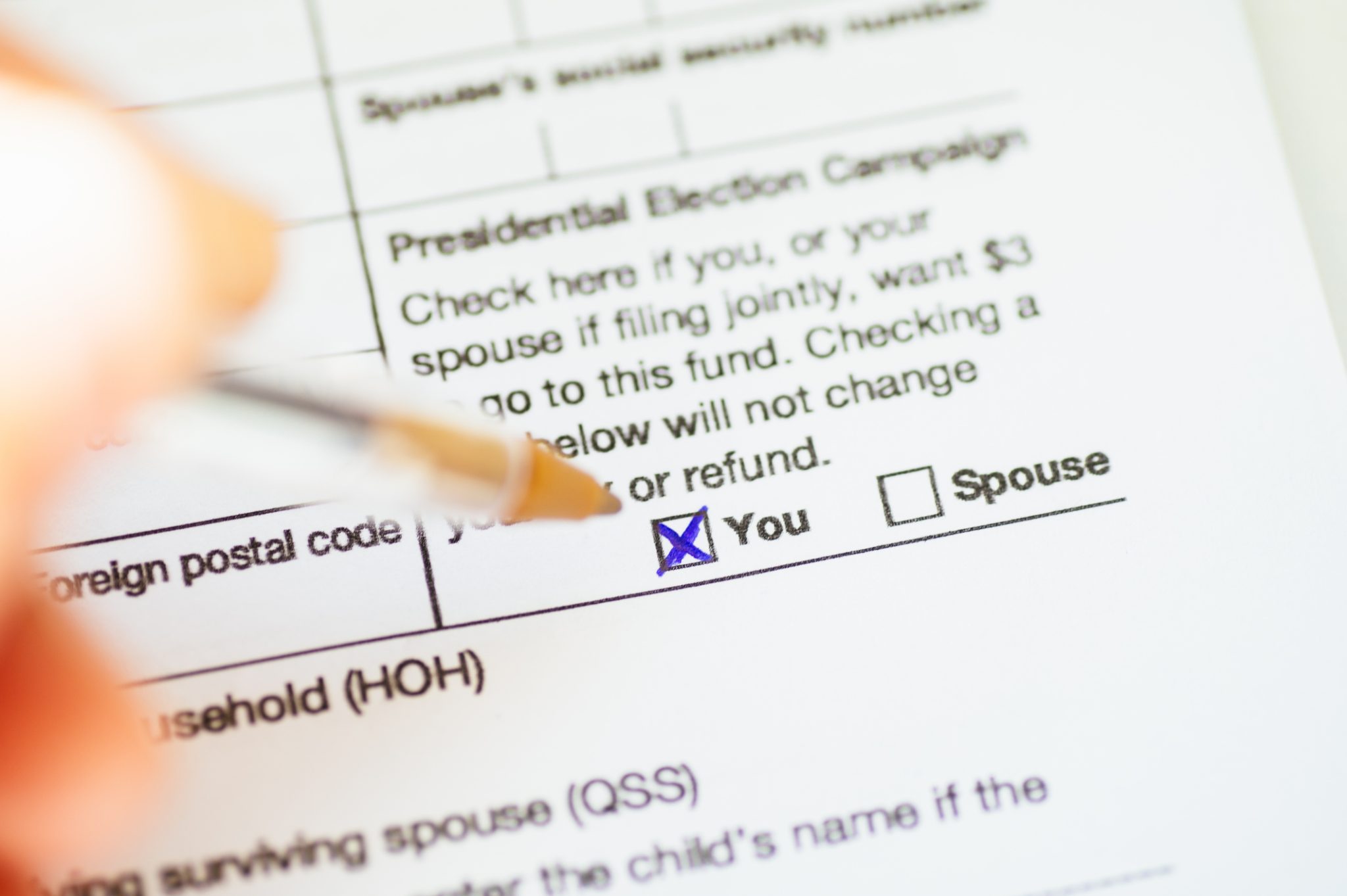
More than 150 million Americans fill out income tax forms every spring. Most scroll past one particular line: a tiny checkbox asking if they want $3 of their taxes to go to the Presidential Election Campaign Fund.
Once a cornerstone of post-Watergate campaign finance reform, the program it supports has become a relic of a bygone era, one that existed before super PACs and unlimited independent spending on elections. Barely 3% of taxpayers participate. Virtually no presidential candidates use it. And in recent years, Congress has siphoned off most of its balance, including a 2024 redirection of more than $300 million to the U.S. Secret Service – leaving the fund with less than $30 million as nof August 2026.
“The reason it exists is just simply inertia,” said Aravind Boddupalli, a researcher at the Urban-Brookings Tax Policy Center who has studied the fund.
Even in a midterm election year with no presidential candidate on the ballot, money continues to dominate the political landscape. House and Senate candidates are poised to shatter campaign spending records, and megadonors are pouring outside dollars into races nationwide. Meanwhile, the nation’s sole public financing system for campaigns sits virtually untouched by candidates while its balance has steadily dwindled.
“The reason why it has essentially disappeared is that it became possible for candidates to raise many, many times more money,” said Kenneth Mayer, a retired political science professor at the University of Wisconsin.
That disconnect between a campaign finance system dominated by private money and a public financing program that has withered into near‑irrelevance raises some central questions: What purpose does the Presidential Election Campaign Fund serve today – and why do the IRS and the Federal Election Commission still ask Americans to support it?
“Policymakers have not come around to removing the program, and I think there’s perhaps some policymakers who see the motivation, the underlying value of the principle of this program existing as still being worthy,” Boddupalli said. “But I think if you were to ask taxpayers what the intended use of the program was … I think they would think this is a mismatch in intent and execution.”
From Teddy Roosevelt to Watergate: The fund’s origins
The roots of the program stretch back more than a century. President Teddy Roosevelt suggested during his 1907 State of the Union address a “very radical measure” – publicly funding “Presidential or National” elections.
He argued that the “need for collecting large campaign funds would vanish” if Congress were to appropriate enough money to cover the expenses of the major parties’ candidates while also acknowledging that “no such law would hamper an unscrupulous man of unlimited means from buying his own way into office.”
Six decades later, Sen. Russell Long (D-La.) attached the Presidential Election Campaign Fund Act of 1966 as a rider to an appropriations bill. Critics blasted the law as an unmonitored “slush fund” for party leaders, and before a single dollar could be collected or spent, Congress froze it in 1967.
Then, in 1971, lawmakers passed the Federal Election Campaign Act – which required candidates to report expenses and contributions – alongside that year’s Revenue Act, which established the modern fund and brought back the tax checkoff. It came with a key catch: Candidates accepting public dollars had to cap their overall spending and refuse private donations. In the aftermath of the Watergate scandal, Congress passed amendments to place limits on contributions to candidates and parties, and established the FEC. Funds from the program also helped finance the two main parties’ presidential nominating conventions between 1976 and 2014, when President Barack Obama signed a law that ended the practice.
“The thought behind it is that it was a way of reducing the influence of private money in presidential elections,” Mayer said.
A steady drop in taxpayers checking the box
Let’s review how it is intended to work, starting with the most visible element of the program – the checkbox.
Found near the top of Form 1040, the checkoff gives filers the option to direct $3 – or $6 for joint filers – to the campaign fund. Although the tax form explicitly states that checking the box won’t affect a filer’s total tax bill or refund, the mechanism is routinely misunderstood. The small-dollar contribution – initially $1, and raised to $3 in 1993 – is not an extra fee tacked onto a tax bill or deducted from a refund check. It is simply allocated out of the existing tax revenue the IRS already collects.
“There tends to be some confusion among taxpayers on whether the money is coming out of their own tax refund or increasing their own tax liability,” Boddupalli said.
Over the course of nearly half a century, the percentage of taxpayers opting in has steadily dropped: Just 3.1% of filers checked the box on their 2024 returns, according to the FEC’s most recent data. That marks a steep decline from the high of 28.7% on 1980 returns.
That echoes a trend Boddupalli said he has observed as a volunteer tax preparer.
“The first question they ask is, ‘Does it impact my own taxes, my own liability? Do you have to pay more? Is it coming out of my refund?’” he said. “And you say, ‘No,’ and then some people say, ‘Sure, why not?’
“And other people have more questions about, ‘Where does the money go?’” he added. “And then there’s a third [group] who are like, ‘Absolutely not – I want nothing to do with the president or presidential elections. So I think that aversion has increased.”
Candidates have abandoned the system, too
That aversion also extends to the candidates.
Here’s how the program was designed to work: During primary elections, the FEC matches funds that qualifying candidates receive from donors up to a predetermined limit. The limit in 2024 of nearly $62 million covered all primary elections, with the per-state scale ranging from $1.2 million in Wyoming to $30 million in California.
To qualify, a candidate must demonstrate broad-based support by raising more than $100,000 – specifically, at least $5,000 in each of 20 states. Because only the first $250 of an individual’s donation counts toward that target, candidates must secure contributions from at least 20 donors per state, a stipulation designed to prevent a single wealthy supporter from simply writing a $5,000 check. Candidates also may spend up to $50,000 in personal funds, and that amount does not count against the spending limit.
The most recent candidate to participate during the primaries was former Vice President Mike Pence, whose 2024 presidential campaign received nearly $1.6 million in federal matching funds.
When it comes to the general election, the structure is a bit different: Major party candidates may receive a grant worth $20 million plus the difference in the price index. In 2024, that worked out to $123.5 million. As in the primary, candidates could spend another $50,000 in personal funds without it counting against the limit. Candidates from minor or new parties, meanwhile, could qualify for partial funding.
Republican George W. Bush in 2000 became the first modern nominee to reject public funds for the primaries and caucuses. The last major party candidate to accept a general election grant was Republican Sen. John McCain, who accepted $84.1 million in 2008.
His opponent that year, Democrat Barack Obama, did not participate. His fundraising haul of $745 million was nearly 10 times the size of McCain’s grant, a statistic that experts say captures the fundamental issue with the program.
“Why would I agree to take this relatively trivial amount of money and agree to limit my spending when I could raise and spend 10 or 20 times more on my own?” Mayer said. “And so it began to see participation atrophy around 2008 and 2012. … Basically, now, there’s no credible candidate who will agree to it because it’s just so easy to raise unlimited amounts of money.”
With candidates largely declining to take part, lawmakers have looked for other ways to spend the money.
Funds in 2014 that would have been earmarked for the nominating conventions were instead steered to a National Institutes of Health pediatric research initiative. A decade later, an appropriations bill redirected $320 million from the campaign fund to the U.S. Secret Service. Those funds were used for general operating expenses, spokesperson Nate Herring told OpenSecrets. And a bill introduced in 2019 would have changed the option on the tax form – sending that $3 not to the election fund but toward building a wall on the southern border. The bill died in committee.
“Using the money for some purpose, instead of having it just sit there, is something,” Boddupalli said. “But I think from a budgeting transparency perspective and based on what taxpayer experience looks like in doing a $3 voluntary checkoff, I think there’s something lacking here and something that needs to be fixed.”
As of Aug. 31, the fund’s balance had fallen below $27.5 million, FEC records show.
“You could basically zero it out,” Mayer said, “and it would have no impact on presidential elections. It’s just completely irrelevant.”
For a program few use, what comes next?
That brings us back to the pivotal questions: If very few taxpayers participate, and almost no candidates accept the money, and the fund has been largely tapped out, why does it continue to exist? And what happens to it in the future – especially in an era of skyrocketing spending on elections?
In 2024, Democratic presidential nominee Kamala Harris and Republican Donald Trump combined to raise $1.6 billion, and outside groups spent an additional $1.8 billion on the race, according to OpenSecrets data.
“There’s so much other spending in elections that the amount the candidate would get from this fund wouldn’t be nearly enough,” Mayer said.
An IRS spokesperson directed questions about the program to the FEC. Spokesperson Myles Martin pointed to the agency’s online description of the fund’s mechanics and declined further comment.
The Bipartisan Policy Center has recommended remaking the program into a dedicated funding source for block grants to state and local election officials, stating in 2022 that such a shift “honors the original spirit” of the fund and would “revitalize election administration in this country and display a commitment from the federal government to cover its role in the state and local voting process.”
In its current configuration, though, Boddupalli – who wrote in 2019 that “it is hard to imagine that the humble Presidential Election Campaign checkoff has much of a future” – remains pessimistic.
“Maybe public financing of elections doesn’t need to happen through the tax code, especially if taxpayers are not aware about where the money is going or if they are aware that the funds are actually severely underutilized,” he said.
The $3 checkbox nobody checks: How a Watergate-era reform became ‘irrelevant’ 2026 THE NEWS FROM BULGARIA – NEWS AGENCY 2009-2025 2026-09-23 12:41:54 Latest news World news Country news Most important news latest news most important latest of the day Justice Petar Nizamov Feathers Petar Nizamov- Feathers Justice bg iustitia.bg iustitia iusticia usticia investigation Burgas Bulgaria news news of the last hour news of the day news of today Bulgaria news The news from Bulgaria blitz news top news most important most commented latest news Boyko Borisov news weather coronavirus news news weather facebook youtube facebook instagram news today news of the last minutes news today today news news bg news leading news hot news bg news site for news all news news bg news of the last hour latest latest news bg news of today news today news today news of the last hour latest news today news bg news news 24 hours news vesti bg novini news world bird bg bivol bg bivol trud bg novini latest news today novinite bg news hello bulgaria political party coat of arms delyan peevski scandalous Bulgarian National Television Free Europe Television scandal exclusive live tv live right now tv tv online tv program bg live now tv news online tv online live court Burgas court Burgas district court Burgas court Burgas district court Burgas district court Burgas appellate court Burgas prosecutor Burgas prosecutor’s office Burgas district prosecutor’s office Burgas district prosecutor’s office Burgas district prosecutor’s office Burgas district prosecutor’s office Burgas district prosecutor’s office Burgas district prosecutor’s office Prosecutor General Ivan Geshev Prosecutor Geshev Tsatsarov Ministry of Internal Affairs Burgas ODMR Burgas ODPR Burgas police Burgas district police Burgas prosecutor Tsatsarov SGS cases Varna court chairman of the SGS court decisions on civil cases decisions on cases Plovdiv court decision of the court decisions cases Varna court criminal cases district district court decisions work in the court SGS chairman of the SGS judges Sofia court post judges Plovdiv court Plovdiv judges Plovdiv Supreme Court Inspectorate Supreme Court Supreme Judicial Council lawyer lawyer criminal cases lawyer civil cases lawyer marriage cases lawyer administrative criminal law criminal process civil law civil process administrative law constitutional law
БЪЛГАРИЯ НОВИНИТЕ – ИНФОРМАЦИОННА АГЕНЦИЯ 2009-2026 2026-09-23 12:41:54