
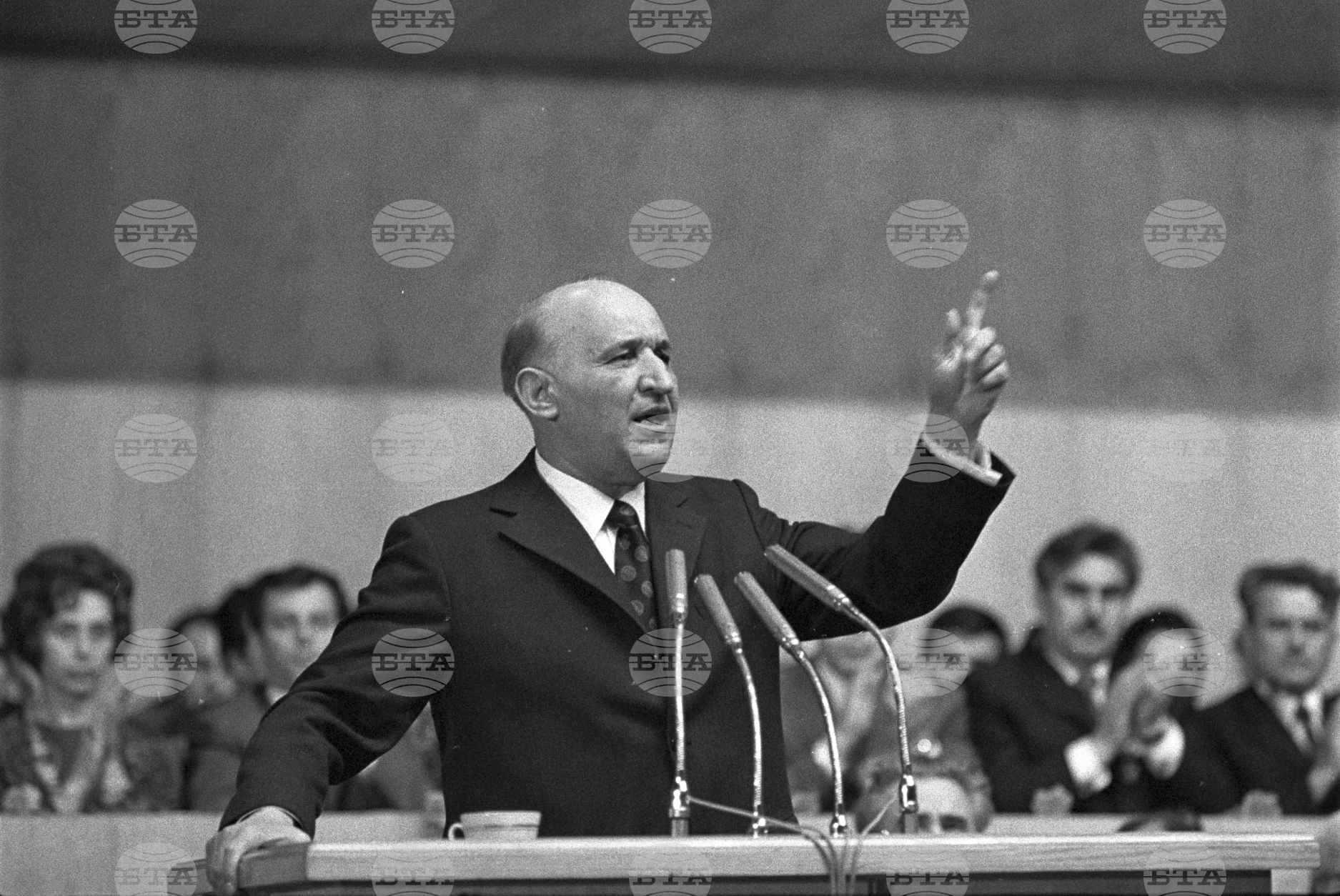
Balgarianovinite.com Fifty-five years ago on Wednesday, Todor Zhivkov, Bulgarian Communist Party (BCP) leader since 1954, became this country’s de facto head of State as the 6th Ordinary National Assembly elected him and the rest of the first complement of the State Council.
In the person of its president, the State Council performed the main functions of head of State of the People’s Republic. Zhivkov created that office for himself and, in this capacity, enjoyed exceptionally wide-ranging powers. He held it irreplaceably for 18 years and four months until his ouster in November 1989. The new position made it possible to further strengthen Zhivkov’s sole grip on power and expand the cult of his personality.
The State Council, established by Bulgaria’s recently adopted Constitution (effective May 18, 1971), had been conceived at the July 1968 Plenum of the BCP Central Committee. It translated into practice the fundamental communist concept of “democratic centralism” and embodied the principle of “unity of state power”, which replaced the classic principle of separation of powers. The Council topped the pyramid of state bodies. It was vested with both legislative and executive powers far greater not only than those of the Presidium of the National Assembly, which it superseded, but even of Parliament and of the Government itself. The Council combined decision-making with decision implementation and control over that implementation. Its powers ranged from cabinet personnel changes to appointing top magistrates, scheduling elections and convening Parliament, appointing and releasing ambassadors and consuls, appointing and releasing the high command of the armed forces, ratifying and denouncing international treaties, ordering mobilization and declaring martial law and a state of war. While at least in some of these cases the decisions of the State Council had to be endorsed by the National Assembly, the latter was increasingly turned into a rubberstamp or was bypassed altogether. Georgi Djagarov, who was part of all complements of the Council, admitted in December 1989: “Year after year, the meetings became less frequent, turning into ritualistic gatherings with the head of State at which no substantive decisions were made. In imposing this style of work, Todor Zhivkov always emphasized that real power lay not with the State Council but with the Central Committee of the Bulgarian Communist Party. During the 1980s, the work of the State Council was purely formal, with one meeting each in 1985 and 1986 and no meetings in 1987 and 1988.”
The State Council consisted of a president, several vice presidents, a secretary and members elected by the National Assembly. While the head of the Council was unquestionable, its line-up was by no means left to chance. The first vice presidents were invariably the leaders of the only other party that was allowed to exist in this country under totalitarianism, the Bulgarian Agrarian National Union, and the two positions were inextricably linked. All members and candidate members of the Politburo of the BCP Central Committee were also members of the State Council, whereas the secretaries of the Central Committee who were not members and candidate members of the Politburo were ineligible for State Council members. The members who were not party top shots were apparently selected to give a semblance of across-the-spectrum representation: Bulgarian Academy of Sciences President Angel Balevski, poet and playwright Georgi Djagarov, Committee of Bulgarian Women Chair Elena Lagadinova, Fatherland Front National Council Secretary Ginyo Ganev, journalist and diplomat Lalyu Ganchev, and even Prosecutor General Vasil Mrachkov.
Since the Constitution did not provide for a set number of members of the State Council, this gave its President the opportunity to “co-opt” figures whom he might consider useful at any given moment, while being able to quietly dismiss others.
Of the 59 individuals who served on the State Council while it existed between 1971 and 1990, only seven served in all four complements, elected by the respective parliaments in 1971, 1976, 1981 and 1986.
When Zhivkov was ousted in a palace coup on November 10, 1989, the deal was that he would only resign as General Secretary of the BCP Central Committee while keeping his position as State Council President. In reality, he lost both jobs and was replaced as head of State by Petar Mladenov on November 17, 1989.
The State Council of the People’s Republic of Bulgaria was abolished on April 3, 1990 by a law amending and supplementing the Constitution that was passed on that date. The functions of the Council were transferred to the newly created institution of Chairman (President) of the Republic. Mladenov was immediately elected to that office.
The President’s Administration also took over the building in central Sofia that until then housed the State Council.
Following is part of an original English-language story by which the News Bulletin weekly of BTA’s External Service of July 13, 1971 reported the establishment of the State Council:
STATE COUNCIL AND BULGARIAN GOVERNMENT
On July 7th and 8th, the First Session of the newly elected Sixth National Assembly of Bulgaria was held in Sofia. The Session elected new supreme organs of state rule and management.
Georgi Traikov, Secretary of the Bulgarian Agrarian Union and outgoing Chairman of the Presidium of the National Assembly, was elected Chairman of the National Assembly and as Deputy-Chairmen were elected Rosa Koritarova and Georgi Koulishev.
In accordance with the newly adopted constitution, a qualitatively new body has been elected in place of the former Presidium of the National Assembly. This new body is the State Council, which is to be the supreme and permanently acting organ of state rule and is to combine the legislative and executive functions of the state. It is composed of 22 members, representing the Bulgarian Communist Party, the Bulgarian Agrarian Union, the political and the mass organisations, and all strata of society. The Sixth National Assembly unanimously elected Todor Zhivkov, the First Secretary of the Central Committee of the Bulgarian Communist Party and outgoing Prime Minister, as Chairman of the State Council, and Krustyu Trichkov, a Candidate-Member of the CC of the BCP Politburo, as First Deputy-Chairman of the State Council. He will also act as Chairman of the State Control Committee. Georgi Andreev, a member of the Standing Committee of the Bulgarian Agrarian Union, Peko Takov, a Candidate-Member of the CC of the BCP Politburo, and Georgi Djagarov, Chairman of the Union of Bulgarian Writers, were approved as Deputy-Chairmen. A decision was also passed by virtue of which the State Control Committee and the State Defence Committee were transferred to the State Council. July 8, 2026: 55 Years since Todor Zhivkov Became De Facto Head of State 2026 THE NEWS FROM BULGARIA – NEWS AGENCY 2009-2025 2026-07-08 12:19:00 Latest news World news Country news Most important news latest news most important latest of the day Justice Petar Nizamov Feathers Petar Nizamov- Feathers Justice bg iustitia.bg iustitia iusticia usticia investigation Burgas Bulgaria news news of the last hour news of the day news of today Bulgaria news The news from Bulgaria blitz news top news most important most commented latest news Boyko Borisov news weather coronavirus news news weather facebook youtube facebook instagram news today news of the last minutes news today today news news bg news leading news hot news bg news site for news all news news bg news of the last hour latest latest news bg news of today news today news today news of the last hour latest news today news bg news news 24 hours news vesti bg novini news world bird bg bivol bg bivol trud bg novini latest news today novinite bg news hello bulgaria political party coat of arms delyan peevski scandalous Bulgarian National Television Free Europe Television scandal exclusive live tv live right now tv tv online tv program bg live now tv news online tv online live court Burgas court Burgas district court Burgas court Burgas district court Burgas district court Burgas appellate court Burgas prosecutor Burgas prosecutor’s office Burgas district prosecutor’s office Burgas district prosecutor’s office Burgas district prosecutor’s office Burgas district prosecutor’s office Burgas district prosecutor’s office Burgas district prosecutor’s office Prosecutor General Ivan Geshev Prosecutor Geshev Tsatsarov Ministry of Internal Affairs Burgas ODMR Burgas ODPR Burgas police Burgas district police Burgas prosecutor Tsatsarov SGS cases Varna court chairman of the SGS court decisions on civil cases decisions on cases Plovdiv court decision of the court decisions cases Varna court criminal cases district district court decisions work in the court SGS chairman of the SGS judges Sofia court post judges Plovdiv court Plovdiv judges Plovdiv Supreme Court Inspectorate Supreme Court Supreme Judicial Council lawyer lawyer criminal cases lawyer civil cases lawyer marriage cases lawyer administrative criminal law criminal process civil law civil process administrative law constitutional law